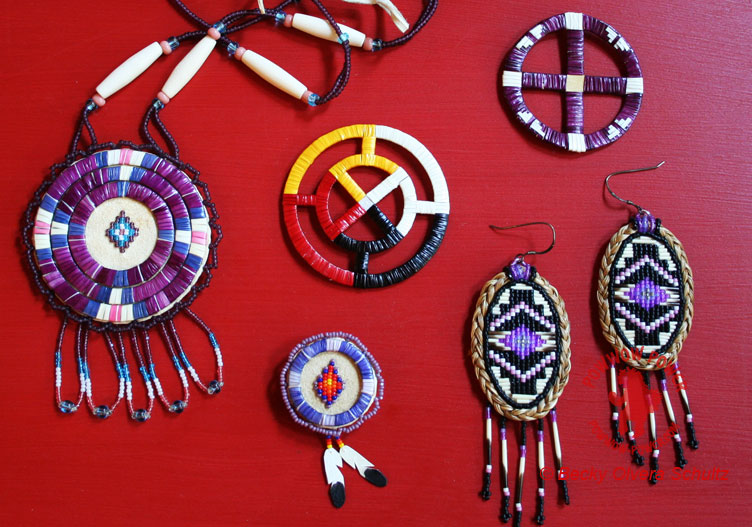

Threads of Time: The Enduring Legacy of Native American Quillwork
In the vast tapestry of human artistry, few forms are as singularly intricate, resourcefully conceived, and culturally profound as Native American quillwork. Long before the gleam of glass beads captured the imagination of Indigenous artisans, it was the humble, barbed quill of the North American porcupine that formed the backbone of a sophisticated and spiritually resonant art. From the Arctic tundra to the Great Plains, for millennia, Indigenous women meticulously transformed these sharp defenses into breathtaking designs, weaving narratives of identity, spirituality, and resilience into every stitch. This ancient craft, a testament to ingenuity and deep connection to the natural world, remains a vibrant, living legacy, continually adapting while honoring its profound historical roots.
The story of quillwork begins with its primary material: the porcupine. Far from being a mere decorative element, the porcupine held a significant place in many Indigenous cosmologies, often associated with protection, wisdom, and resourcefulness. Harvesting quills was a delicate and respectful process. While quills naturally shed, skilled artisans might gently encourage a porcupine to release its quills by throwing a blanket over it, or by carefully plucking them after a successful hunt, always with profound gratitude and never harming the animal. Once collected, the quills, numbering in the tens of thousands for a single elaborate piece, underwent a rigorous preparation. They were cleaned, sorted by size, flattened by drawing them between teeth or using bone tools, and then dyed.
The palette of early quillwork was a symphony of natural hues derived from the earth itself. Berries, roots, bark, and minerals yielded a spectrum of vibrant colors: crimson from bloodroot, deep blue from wild grapes or indigo, sunny yellow from lichen, and earthy browns from walnuts or oak bark. Each color often carried symbolic meaning, contributing to the narrative embedded within the designs. This labor-intensive preparation was itself an act of devotion, transforming a natural defense into a medium for artistic and spiritual expression.
The techniques employed in quillwork were as varied as the tribes that practiced them. Primarily a women’s art, quillwork was a highly respected skill passed down through generations. Masters of the craft demonstrated unparalleled patience and dexterity, manipulating the flattened quills through a complex array of methods: wrapping, sewing, plaiting, and weaving onto softened hides, birchbark, or even gut. Simple wrapping involved winding quills around strands of hair or sinew, creating geometric bands. Sewing involved piercing the hide with a bone or metal awl, pushing a quill through, folding it, and securing it with sinew, creating intricate patterns that lay flat against the surface. Plaiting and weaving techniques, often used for bands and strips, produced durable and visually striking textures.
These intricate designs adorned nearly every aspect of ceremonial and daily life. From the regalia of chiefs and spiritual leaders – shirts, leggings, and moccasins – to personal items like pipe stems, pouches, knife sheaths, and cradleboards, quillwork imbued objects with beauty, power, and cultural significance. A quilled war shirt, for instance, was not merely clothing; it was a testament to the wearer’s achievements, spiritual protection, and tribal identity. Geometric patterns, often precise and symmetrical, could represent landscapes, celestial bodies, animal tracks, or sacred visions. For the Lakota, the "quillworkers’ society" held significant prestige, ensuring the continuation of this sacred art form.


The arrival of European traders brought new materials and, initially, new opportunities. The introduction of metal awls and needles made the piercing of hides easier and more precise, enabling even finer work. However, it was the introduction of glass beads, particularly from the 17th century onwards, that presented both a challenge and an evolution for quillwork. Beads, readily available and often easier to work with, quickly gained popularity. Yet, for many tribes, quillwork retained its prestige as the "original" and most authentic art form. It was often reserved for the most sacred objects and ceremonial regalia, with beads sometimes used to complement or outline quilled designs rather than entirely replace them. This period saw a fascinating convergence, where artisans skillfully blended old and new, demonstrating remarkable adaptability without abandoning tradition.
The 19th and early 20th centuries, however, brought profound disruptions that severely threatened the survival of quillwork. Forced assimilation policies, including the establishment of boarding schools that actively suppressed Indigenous languages and cultural practices, severed the vital intergenerational transmission of knowledge. As traditional ways of life were dismantled, the demand for quilled regalia diminished, and the art form began to wane in many communities. The sheer labor involved, coupled with the increasing availability of mass-produced goods, further contributed to its decline. For a time, it seemed this ancient art might be relegated to museum exhibits, a relic of a bygone era.
Yet, like many aspects of Native American culture, quillwork refused to vanish. The latter half of the 20th century witnessed a powerful resurgence, fueled by a renewed sense of Indigenous pride, cultural revitalization movements, and the dedicated efforts of a few passionate artists. Elders, who had quietly preserved the knowledge, began to share their skills with younger generations eager to reclaim their heritage. Institutions and cultural centers played a crucial role in documenting historical pieces and providing spaces for teaching.
Today, Native American quillwork is a testament to resilience and the enduring spirit of Indigenous artistry. Contemporary quillworkers are not merely replicating old designs; they are innovating, pushing the boundaries of the art form while honoring its foundational principles. Artists like Yvonne Walker Keshick (Odawa/Ojibwe) and Juanita Growing Thunder Fogarty (Hunkpapa Lakota/Dakota/Assiniboine) are celebrated masters, their works found in prestigious collections worldwide. They create traditional regalia with meticulous accuracy, but also explore new applications: contemporary jewelry, wall art, and sculptural pieces that speak to modern sensibilities while echoing ancient wisdom.
The process remains intensely personal and demanding. A single piece can take hundreds of hours, demanding unwavering focus and a deep respect for the material. "Every quill is a prayer," one contemporary artist might say, encapsulating the spiritual dimension inherent in the work. The act of preparing, dyeing, and manipulating each quill becomes a meditative practice, a connection to ancestors, and a reaffirmation of identity.
The future of Native American quillwork is bright, sustained by the unwavering dedication of its practitioners and the growing appreciation for its profound beauty and historical significance. It serves as a powerful reminder of the ingenuity, artistic brilliance, and cultural tenacity of Indigenous peoples. From the sharp defenses of a porcupine to a masterwork of human creativity, quillwork stands as more than just an art form; it is a living chronicle, a vibrant thread weaving together the past, present, and future of Native American heritage. In every delicate fold and vibrant hue, it speaks of a culture that honors its roots, adapts to change, and continues to tell its stories with unmatched grace and enduring power.


