

Echoes in Clay: The Enduring Legacy and Resurgence of Native American Pottery
The story of Native American pottery is not merely an account of craft; it is a profound narrative etched in clay, spanning millennia and echoing the spiritual, cultural, and practical lives of countless Indigenous peoples across the vast North American continent. From the earliest rudimentary vessels to the sophisticated, highly prized works of contemporary artists, pottery has served as a tangible link between generations, a canvas for cosmological beliefs, and a testament to unparalleled ingenuity and resilience.
To hold a piece of ancient Native American pottery is to grasp a fragment of history, to feel the silent stories of hands that shaped earth and fire into objects of utility, ceremony, and beauty. It speaks of a deep, intimate relationship with the land, where the very soil provided not just sustenance but also the medium for artistic and cultural expression.
The Ancient Roots: A Timeless Craft Emerges
The origins of pottery in North America stretch back thousands of years, with some of the earliest evidence dating to around 2500 BCE in the Southeastern United States, particularly in the Stallings Island culture of Georgia and South Carolina. These early vessels, often tempered with plant fibers, marked a revolutionary shift in human capabilities, allowing for more efficient cooking, storage, and transport of food and water than previously possible with baskets or gourds.
As techniques evolved and spread, often along trade routes and through cultural exchange, pottery became an indispensable aspect of daily life for numerous societies. By 200 CE, the craft had flourished across the Southwest, the Mississippi Valley, and parts of the Eastern Woodlands, each region developing distinctive styles, forms, and decorative motifs reflecting their unique environments and worldviews.


In the American Southwest, the Ancestral Puebloans (formerly known as Anasazi) were masterful potters, whose work from sites like Chaco Canyon, Mesa Verde, and Canyon de Chelly showcases a remarkable progression in design and technique. Their black-on-white pottery, geometric patterns, and later, the striking polychrome designs, are hallmarks of a culture deeply connected to the land and sky. The Mimbres people, a branch of the Mogollon culture, produced some of the most iconic and enigmatic pottery between 1000 and 1150 CE. Their black-on-white bowls, often found intentionally "killed" (a hole punched through the bottom) in burials, depict intricate, often whimsical, and highly stylized anthropomorphic, zoomorphic, and geometric figures. These designs are believed to represent spirit beings, daily life, and cosmological narratives, offering a tantalizing glimpse into their spiritual universe.
Further east, the Mississippian cultures (c. 800–1600 CE), centered around monumental sites like Cahokia, also developed highly sophisticated pottery traditions. Known for their diverse forms, including effigy pots shaped like humans, animals, and mythological creatures, and often tempered with crushed mussel shells, their vessels served ceremonial, funerary, and domestic purposes. These pots often carried complex iconography related to the Southeastern Ceremonial Complex, reflecting shared beliefs and elite status.
The Art of Creation: Materials, Methods, and Meaning
The creation of Native American pottery was, and largely remains, a labor-intensive and deeply spiritual process. It begins with the respectful gathering of clay, often from specific, ancestral sites. As one elder from the Acoma Pueblo once noted, "The clay is our mother; she gives us life and form." This sentiment underscores the profound respect and sacredness attributed to the raw material.
Once collected, the clay is meticulously processed, cleaned of impurities, and combined with temper – materials like sand, crushed rock, volcanic ash, or even ground-up pot sherds (known as grog). Temper is crucial; it prevents the clay from cracking during drying and firing, and different types of temper impart unique characteristics to the finished product.
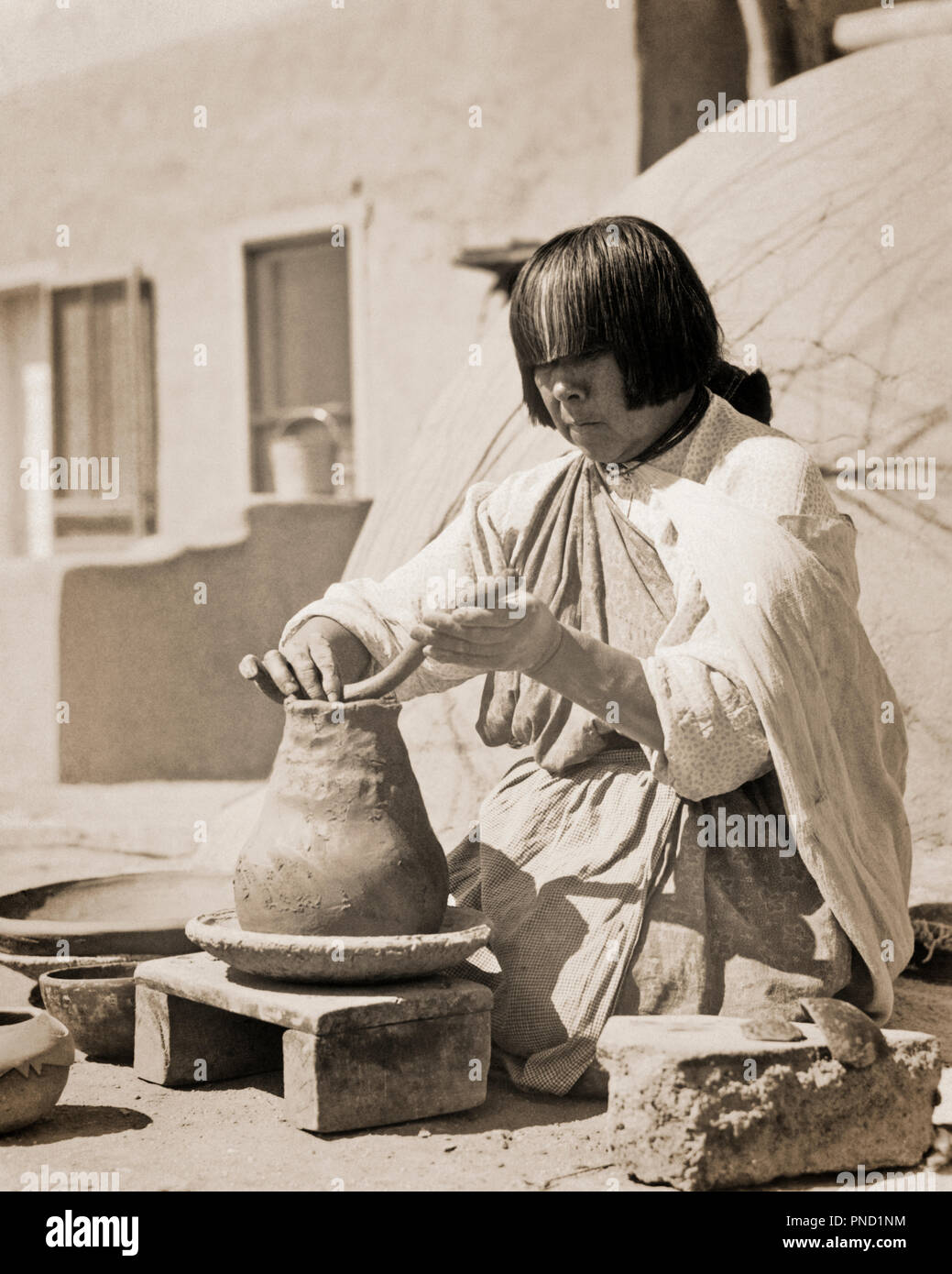
The most common construction method across Native North America was coiling. Potters would roll out long, snake-like coils of clay and then systematically stack and blend them, spiraling upward from a flat base to build the vessel’s form. This technique allowed for immense creativity in shaping, from simple utilitarian jars to complex, sculptural forms. Pinching was used for smaller vessels, and slab construction for more angular pieces.
Decoration was applied after the pot was formed and dried to a "leather-hard" stage. This could involve slipping (applying a thin, liquid clay coating for color or texture), incising (carving designs into the surface), or painting. Paints were derived from natural pigments: mineral oxides for reds, yellows, and blacks, or organic materials like beeplant for deep black. Brushes were often fashioned from yucca fibers, animal hair, or even chewed sticks, allowing for incredible precision and detail. Polishing with smooth stones, sometimes for hours, created a lustrous, sealed surface.
Firing was the final, transformative step. Most traditional Native American pottery was fired in open pits or low-temperature kilns. The control of oxygen during firing was critical, particularly for the distinctive blackware of the Pueblo people. By smothering the fire with organic materials like dung or cedar chips at a specific stage, oxygen is reduced, causing the carbon to impregnate the clay, turning it a deep, lustrous black. This process is a testament to an ancient understanding of chemistry and thermodynamics.
Beyond aesthetics, the designs etched or painted onto pots were rarely arbitrary. They were often imbued with deep cultural meaning: clan symbols, representations of natural forces (clouds, lightning, rain), animal spirits, human figures engaged in ceremonies, or abstract patterns that conveyed cosmological order. A pot was not just a container; it was a narrative, a prayer, a connection to the ancestors and the spiritual world.

A Period of Peril and the Seeds of Revival
The arrival of European colonizers brought profound disruption to Native American societies, and traditional pottery was not immune. Disease, warfare, forced relocation, and the introduction of new materials like metal cooking pots and ceramic vessels from Europe led to a decline in pottery production in many regions. Knowledge systems were fractured, and the economic necessity of creating pottery for daily use diminished. For a time, it seemed that some ancient techniques and designs might be lost forever.
However, the late 19th and early 20th centuries saw the seeds of a remarkable revival, particularly in the American Southwest. Anthropologists, collectors, and early tourists began to appreciate Native American pottery not just as ethnographic curiosities but as fine art. This external interest, combined with the unwavering dedication of certain Indigenous artists, sparked a renaissance.
Perhaps the most celebrated figure in this revival was Maria Martinez (1887-1980) of San Ildefonso Pueblo, New Mexico. Collaborating with her husband, Julian, Maria rediscovered the ancient technique of producing matte-on-polished blackware pottery, a method that had been lost for centuries. Her exquisite, perfectly formed vessels, with Julian’s elegant, precise designs, captivated the world. Maria’s commitment to quality, her willingness to share her knowledge, and her entrepreneurial spirit not only revitalized the pottery tradition at San Ildefonso but also created an economic foundation for her community. Her work elevated Native American pottery to an internationally recognized art form.
Another pivotal figure was Nampeyo (c. 1859–1942), a Hopi-Tewa potter from Hano village on First Mesa. Inspired by archaeological excavations at the ancient Sikyatki village, Nampeyo brilliantly revived and reinterpreted the distinctive, fluid, and often bird-inspired designs of her ancestors. Her innovative artistry breathed new life into Hopi pottery, establishing a legacy that continues through generations of her descendants.
These women, and many others like them, were not just artists; they were cultural custodians, ensuring that the wisdom embedded in clay continued to flow through their communities.
Contemporary Clay: Tradition, Innovation, and Resilience
Today, Native American pottery thrives as a vibrant and evolving art form. Contemporary potters grapple with the complex interplay of tradition and innovation, preserving ancestral techniques while also pushing the boundaries of artistic expression.
Challenges persist: sourcing traditional clays and tempers can be difficult in a modern landscape; the economic pressures of the art market sometimes clash with the spiritual integrity of the craft; and issues of cultural appropriation, where non-Native artists imitate Indigenous styles without proper understanding or attribution, remain a concern. Passing on the intricate, hands-on knowledge to younger generations in an increasingly digital world also requires concerted effort.
Yet, the triumphs are numerous. Native American potters are celebrated in museums, galleries, and private collections worldwide. They are blending ancient forms with contemporary aesthetics, experimenting with new glazes and firing techniques, and creating sculptural pieces that speak to modern experiences while remaining deeply rooted in cultural heritage. Many artists see their work as an act of sovereignty, a declaration of identity, and a continuous prayer.
As Robert K. F. Roessel Jr., a Navajo educator, once eloquently stated about Native arts, "It is not merely a product; it is a process of being." This "process of being" is evident in every coil, every brushstroke, and every firing of Native American pottery. It is a living art form, a testament to the enduring creativity, spiritual depth, and unyielding resilience of Indigenous peoples. From the earliest pots that held the seeds of survival to the masterpieces that adorn modern collections, Native American pottery continues to speak, carrying the echoes of ancestors into an unfolding future, ensuring that the voice of the clay will never be silenced.


