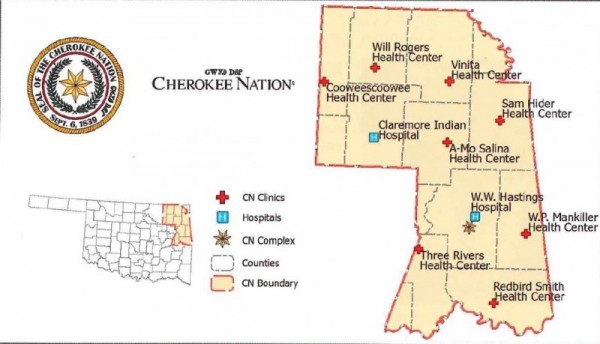

The concept of ‘reservation boundaries’ for the Cherokee Nation is far more intricate than a simple line on a map. It encompasses centuries of history, solemn treaties, forced removals, and, most recently, a landmark Supreme Court decision that has reshaped jurisdictional understanding in Northeastern Oklahoma. For many, the term ‘reservation’ conjures images of distinct, enclosed land areas, but for the Cherokee Nation, its boundaries define a vast expanse of ‘Indian Country’ with profound legal and governmental implications.
Understanding these boundaries requires a journey back in time, to the era of treaties between sovereign nations. The Cherokee Nation, one of the largest federally recognized tribes in the United States, has a rich and resilient history. Their ancestral lands once spanned much of the southeastern U.S. before the tragic forced removal known as the Trail of Tears, which relocated them to Indian Territory, now Oklahoma.
Upon their arrival in Indian Territory, the Cherokee Nation, along with other Five Civilized Tribes, established a new government and a defined territory through a series of treaties with the U.S. government. These treaties, particularly the Treaty of New Echota (1835) and the Treaty of Fort Smith (1846), set forth the legal framework for the Cherokee Nation’s lands and sovereignty.
For decades, the precise legal status of these treaty-defined boundaries, especially concerning criminal jurisdiction, remained a complex and often disputed issue. While tribal governments continued to operate within their historical territories, state jurisdiction often asserted dominance over non-tribal members and certain crimes.
This changed dramatically with the 2020 Supreme Court decision in McGirt v. Oklahoma. This monumental ruling affirmed that a significant portion of eastern Oklahoma, encompassing much of the Cherokee Nation’s historical treaty lands, remains ‘Indian Country’ for purposes of the Major Crimes Act.
The McGirt v. Oklahoma Decision: A Game Changer


The McGirt case centered on a Muscogee (Creek) Nation tribal member convicted in state court. The question before the Supreme Court was whether the Muscogee (Creek) Nation’s reservation, established by treaty, had ever been disestablished by Congress. The Court ruled decisively that it had not.
Justice Gorsuch, writing for the majority, emphasized that ‘Congress must clearly evince an intent to disestablish or diminish a reservation.’ Without such clear congressional action, the historical boundaries established by treaty remain intact. This principle was then applied to the Cherokee Nation and other Five Civilized Tribes through subsequent court decisions.
The implications of McGirt are far-reaching. For the Cherokee Nation, it affirmed that their 1866 treaty boundaries, encompassing approximately 7,000 square miles across 14 counties in Northeastern Oklahoma, indeed constitute ‘Indian Country.’
What Does ‘Indian Country’ Mean for the Cherokee Nation?
The term ‘Indian Country’ is a legal definition found in federal law (18 U.S.C. § 1151). It refers to:
- All land within the limits of any Indian reservation under the jurisdiction of the United States Government, notwithstanding the issuance of any patent, and including rights-of-way running through the reservation,
- All dependent Indian communities within the borders of the United States whether within or without the limits of a state, and
- All Indian allotments, the Indian titles to which have not been extinguished, including rights-of-way running through the same.
Crucially, within Indian Country, tribal governments generally have inherent jurisdiction over crimes committed by or against tribal members. This means that serious crimes involving tribal members within the Cherokee Nation’s boundaries fall under federal or tribal jurisdiction, rather than state jurisdiction.
This jurisdictional shift has led to significant changes in law enforcement, criminal prosecution, and social services within the affected areas. The Cherokee Nation’s justice system, including its tribal courts and law enforcement, has seen a substantial increase in caseloads and responsibilities.
Geographic Scope: The 14 Counties
The Cherokee Nation’s reservation boundaries, as reaffirmed by McGirt, encompass all or parts of 14 counties in Northeastern Oklahoma. These include Adair, Cherokee, Craig, Delaware, Mayes, McIntosh, Muskogee, Nowata, Ottawa, Rogers, Sequoyah, Tulsa (east of the Arkansas River), Wagoner, and Washington counties.
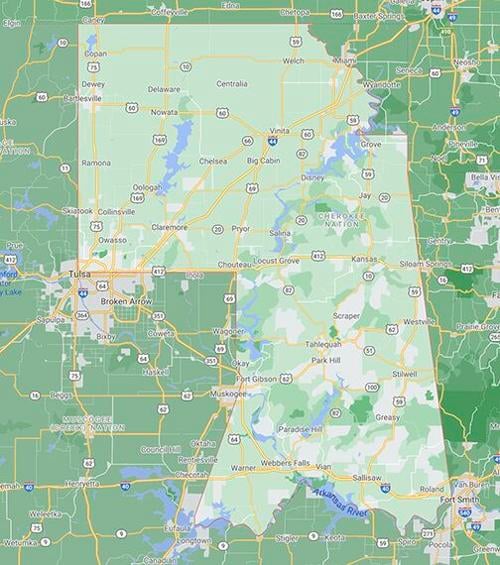

It’s important to note that this is not a ‘closed’ reservation where only tribal members can reside. These counties are home to both tribal citizens and non-Native residents, businesses, and state infrastructure. The boundaries define a jurisdictional landscape, not a demographic one.
Impacts on Jurisdiction: Beyond Criminal Justice
- Civil Jurisdiction: Tribal courts may have increased authority over civil disputes involving tribal members within the reservation boundaries.
- Taxation: The ability of the state to tax tribal members and tribal entities within Indian Country is limited, leading to complex state-tribal tax agreements.
- Environmental Regulation: Tribal governments can exert greater authority over environmental protection and resource management within their territories.
- Business and Economic Development: Tribal nations have enhanced regulatory and governmental powers that can influence economic development projects within their boundaries.
These changes necessitate intricate intergovernmental agreements and ongoing dialogue between the Cherokee Nation, the State of Oklahoma, and federal agencies to ensure seamless governance and service provision for all residents.
Addressing Common Questions (People Also Ask)
Is the Cherokee Nation a sovereign nation? Yes, the Cherokee Nation is a federally recognized sovereign tribal nation with its own government, laws, and judicial system. The McGirt decision further affirmed the extent of its territorial sovereignty.
What is the difference between a reservation and ‘Indian Country’? While ‘reservation’ is a common term for lands set aside for Native American tribes, ‘Indian Country’ is a specific legal term defined by federal statute (18 U.S.C. § 1151) that includes reservations, dependent Indian communities, and allotments. The Cherokee Nation’s historical treaty lands fall under this legal definition.
How many counties are in the Cherokee Nation reservation? The affirmed Cherokee Nation reservation encompasses all or parts of 14 counties in Northeastern Oklahoma.
Do I need a special ID to live there if I’m not Native American? No, residency within the Cherokee Nation’s boundaries does not require a special ID for non-Natives. These areas are not closed off; they are part of the broader Oklahoma landscape. However, being a tribal citizen has implications for jurisdiction if involved in certain legal matters.
What does this mean for property owners within the boundaries? For most private property owners, the immediate impact on property deeds or ownership is minimal. The ruling primarily affects governmental jurisdiction. However, it can influence taxation for tribal members and certain land-use regulations involving tribal government interests.
Can non-Natives live on the Cherokee Nation reservation? Absolutely. The vast majority of people living within the Cherokee Nation’s affirmed boundaries are not tribal citizens. The jurisdictional changes affect who has authority over certain crimes and civil matters, not who can reside there.
Challenges and Collaborations
Implementing the McGirt decision has presented significant challenges, particularly in coordinating law enforcement and judicial processes. The State of Oklahoma and the Cherokee Nation, along with other affected tribes, have been engaged in extensive negotiations to establish cooperative agreements. These agreements aim to clarify roles, share resources, and ensure public safety for all residents.
The Cherokee Nation has significantly expanded its law enforcement and judicial infrastructure to meet the increased demands. This includes hiring more tribal police officers, expanding court facilities, and developing new tribal codes and regulations to address the complex jurisdictional landscape.
These intergovernmental efforts highlight the ongoing evolution of state-tribal relations and the commitment to finding practical solutions that respect tribal sovereignty while maintaining effective governance for all citizens.
The Future Outlook
The reaffirmation of the Cherokee Nation’s reservation boundaries marks a pivotal moment in tribal sovereignty and federal Indian law. It underscores the enduring power of treaties and the unique government-to-government relationship between tribal nations and the United States.
As the practical implications continue to unfold, the focus remains on strengthening intergovernmental relationships, ensuring justice, and promoting the well-being of all individuals residing within these historically significant boundaries. The Cherokee Nation continues to assert its inherent governmental authority, contributing to the rich tapestry of governance in Oklahoma and the nation.
Conclusion
The Cherokee Nation reservation boundaries are not merely lines on a map; they represent a vibrant, living history of resilience, sovereignty, and ongoing nation-building. The McGirt v. Oklahoma decision unequivocally affirmed these boundaries as ‘Indian Country,’ fundamentally reshaping jurisdictional understanding in Northeastern Oklahoma.
This means that within a significant portion of the state, particularly across 14 counties, federal and tribal governments hold primary jurisdiction over certain matters involving tribal citizens. While complex, this affirmation upholds treaty rights and tribal sovereignty, necessitating continued collaboration between the Cherokee Nation, the State of Oklahoma, and the federal government to ensure effective governance for all residents. Understanding these boundaries is key to appreciating the unique legal and historical landscape of modern Oklahoma.


