

The Arctic, a landscape often perceived as barren and unforgiving, is in fact teeming with life, much of it unseen to the untrained eye. For millennia, the Inuit, the Indigenous people of the Arctic regions of Canada, Greenland, and Alaska, have not only survived but thrived in this challenging environment. Their survival is a testament to profound ingenuity, adaptability, and an unparalleled understanding of the land, sea, and its subtle resources.
Central to this enduring resilience is the Inuit’s intricate knowledge of traditional plant uses. Far from relying solely on marine mammals and caribou, plants have always played a critical, multifaceted role in their diet, medicine, tools, and cultural practices. This deep ethnobotanical wisdom, passed down through generations, offers invaluable insights into sustainable living and human adaptation.
This comprehensive guide delves into the fascinating world of Inuit traditional plant uses, exploring how these remarkable plants sustained communities, healed ailments, and enriched cultural life in one of the planet’s most extreme environments.
The Arctic Ecosystem: A Cradle of Unique Flora
The Arctic environment presents unique challenges for plant life: short growing seasons, permafrost, harsh winds, and limited sunlight. Yet, a diverse range of hardy plants has adapted to these conditions, often growing low to the ground, with dense root systems, and rapid life cycles.
From delicate wildflowers to robust shrubs and various mosses and lichens, the Arctic flora is a testament to nature’s resilience. The Inuit have learned to identify, harvest, and utilize these plants with an unmatched precision, transforming what outsiders might see as sparse vegetation into a vital larder and pharmacy.


Beyond Sustenance: The Multifaceted Role of Arctic Plants
While often overshadowed by the importance of hunting and fishing in traditional Inuit life, plants provided crucial dietary supplements, especially vitamins and minerals often lacking in a meat-heavy diet. They prevented scurvy, boosted immunity, and offered much-needed variety.
Their applications extended far beyond food, encompassing sophisticated medicinal practices, the creation of tools and materials, and holding significant cultural and spiritual meaning.
Food: The Arctic’s Hidden Harvest
Many Arctic plants are rich in nutrients, antioxidants, and fiber. The Inuit skillfully harvested a variety of berries, roots, leaves, and even seaweeds during the brief summer months, preserving them for winter use through drying, freezing, or storing in seal oil.
- Paurngarutit (Crowberry): A staple, these dark, tart berries are abundant and rich in Vitamin C. They are often eaten fresh, frozen, or mixed with seal fat.
- Aqpiit (Cloudberry): Highly prized for their sweet-tart flavor and high vitamin content, cloudberries are often called ‘Arctic gold.’ They are eaten fresh or made into jams.
- Kigutigarnat (Blueberry/Bilberry): Similar to their southern counterparts, Arctic blueberries provide essential vitamins and antioxidants.
- Pinguat (Mountain Sorrel): The sour leaves are rich in Vitamin C and can be eaten fresh to combat scurvy.
- Tuktujaat (Fireweed): Young shoots can be eaten raw or cooked, and the leaves can be brewed into a tea.
- Scurvy Grass (Cochlearia officinalis): As its name suggests, this plant is packed with Vitamin C and was crucial in preventing scurvy.
- Arctic Willow (Salix arctica): The young leaves and inner bark are edible, offering a source of vitamins and minerals.
Medicine: The Arctic Pharmacy
Inuit traditional medicine relies heavily on plants for treating a wide range of ailments, from common colds and infections to pain relief and wound healing. Knowledge of these remedies was often held by elders and traditional healers (Angakkuit).
- Mamaittuqutik (Labrador Tea): Leaves are brewed into a potent tea used for colds, coughs, and sore throats. It also has antiseptic properties.
- Uqpiik (Arctic Willow): The bark and leaves contain salicin, a compound similar to aspirin, used for pain relief, fever, and inflammation.
- Qulliq (Lampwick Plant/Arctic Cotton): While not strictly medicinal in consumption, the fluffy seeds were used as dressings for wounds and burns due to their absorbent properties.
- Nunavut Stonecrop (Sedum): Used for treating skin irritations and wounds, often applied as a poultice.
- Tungujuit (Purple Saxifrage): Used for various ailments, including respiratory issues and as a general tonic.
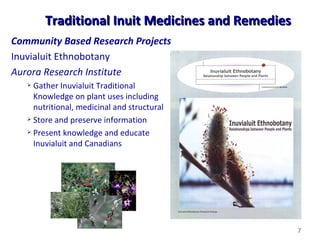

Tools, Materials, and Fuel: Ingenuity in the Arctic
Plants also provided essential materials for daily life, demonstrating the Inuit’s remarkable ability to utilize every available resource.
- Uqpiik (Arctic Willow): Stems were used for making tool handles, fishing rods, and even small bows. Its branches could also be used as a low-grade fuel for fires.
- Qulliq (Lampwick Plant/Arctic Cotton): The fibrous seeds were crucial as wicks for the traditional oil lamp (qulliq), providing light and heat in igloos and tents.
- Mosses and Lichens: Used as insulation, bedding, and even as a primitive form of toilet paper. Certain lichens were also used for dyeing materials.
- Kukiligaq (Bearberry): Leaves were sometimes mixed with tobacco for smoking, or brewed for medicinal purposes.
Cultural and Spiritual Significance
Beyond their practical applications, plants are interwoven with Inuit culture, stories, and spiritual beliefs. The annual harvesting of berries, for instance, is a communal activity, strengthening family bonds and transmitting knowledge.
Certain plants may feature in traditional narratives, ceremonies, or as symbols of resilience and life in the harsh Arctic environment. The deep respect for the land and its offerings is a cornerstone of Inuit worldview.
Preserving and Transmitting Knowledge
The transmission of traditional plant knowledge has historically been oral, passed down from elders to younger generations through direct teaching, observation, and participation in harvesting activities. This intergenerational learning is vital for cultural continuity.
Today, efforts are being made to document and revitalize this knowledge through educational programs, community initiatives, and collaborations with scientific researchers, ensuring its survival in a rapidly changing world.
Challenges and Modern Relevance
The traditional use of plants faces modern challenges, including climate change, which alters plant distribution and growing seasons, and the increasing availability of store-bought foods and medicines.
Despite these challenges, there’s a renewed interest in traditional foods and medicines among Inuit communities, driven by a desire to reconnect with cultural heritage, promote health, and achieve food security.
Furthermore, scientific research is increasingly validating the nutritional and medicinal properties of Arctic plants, highlighting their potential benefits for broader global health and wellness.
Respectful Engagement with Indigenous Knowledge
It is paramount to approach the study and appreciation of Inuit traditional plant uses with profound respect for Indigenous knowledge systems. This includes acknowledging intellectual property, seeking consent for research, and ensuring that any benefits derived are shared equitably with the communities.
Understanding these practices is not just about cataloging plants; it’s about recognizing the sophisticated science and deep ecological understanding embedded within Inuit culture.
Conclusion: A Legacy of Wisdom and Adaptation
The traditional plant uses of the Inuit stand as a powerful testament to human ingenuity and the enduring wisdom of Indigenous cultures. In a landscape that demands constant adaptation, the Inuit have cultivated an intimate relationship with their environment, harnessing the subtle power of Arctic flora for survival, sustenance, and healing.
This legacy of knowledge continues to inspire, offering valuable lessons in sustainability, resilience, and the profound interconnectedness between humanity and the natural world. As we look to the future, preserving and learning from these traditions becomes ever more crucial for understanding both our past and charting a sustainable path forward.


