
The Arctic, a realm of breathtaking beauty and unforgiving extremes, has for millennia been home to resilient indigenous peoples. Far from being a barren wasteland, it is a landscape rich with life and subtle clues, understood deeply by those who call it home. Among the most remarkable skills developed by these communities is their sophisticated system of navigation, particularly their profound understanding of the celestial sphere. Without modern instruments, their ability to traverse vast distances across ice, snow, and open water was nothing short of extraordinary.
When discussing these ancient navigational techniques, it’s important to clarify terminology. The term ‘Eskimo’ is often used broadly but can be considered outdated or even pejorative by some. More accurate and respectful terms refer to specific cultural groups, such as the Inuit across Canada and Greenland, the Yup’ik in Alaska and Siberia, and the Iñupiat in northern Alaska. While this article uses ‘Eskimo Navigation Stars’ for SEO purposes, we acknowledge and celebrate the distinct heritage of these diverse Arctic peoples, whose celestial knowledge is a shared testament to human ingenuity.
Their navigational system was holistic, integrating an intimate knowledge of landforms, ice formations, wind patterns, currents, and animal behavior with precise observations of the sun, moon, and stars. This comprehensive approach allowed them to create a mental map of their world, constantly updated by subtle environmental cues. Celestial bodies, however, often provided the most reliable and consistent guides, especially during long nights or featureless stretches of ice.
Celestial Guides: The Stars of the North
The night sky above the Arctic is a spectacle, often clear and vibrant, presenting a natural compass. Indigenous navigators developed an intricate understanding of star patterns, their movements, and their practical applications for orientation and timing. Their knowledge wasn’t just observational; it was deeply interwoven with cultural stories, myths, and traditions.
Polaris: The Unmoving Anchor


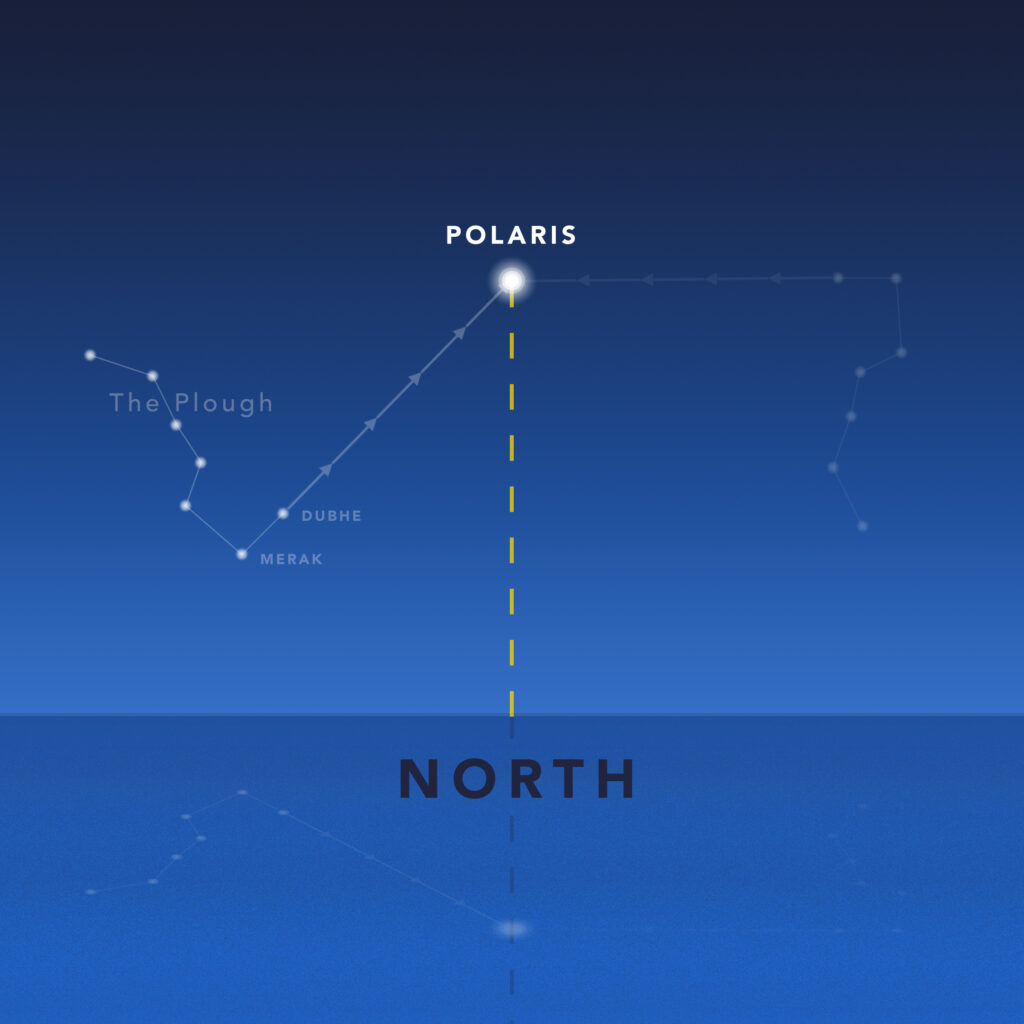
At the heart of Arctic celestial navigation lies Polaris, the North Star. Unlike other stars that appear to rotate around the celestial pole, Polaris remains virtually fixed in the northern sky. For anyone traveling in the Northern Hemisphere, finding Polaris immediately gives a true north bearing, a critical reference point in a landscape often devoid of distinct landmarks.
Indigenous navigators knew how to locate Polaris with remarkable accuracy. They understood that it marked the direction of the Earth’s axis, a constant beacon that could guide them across vast, featureless expanses of ice and tundra. This star was often called ‘Niqirtsuituq’ by the Inuit, meaning ‘the one that never moves,’ underscoring its pivotal role.
Ursa Major (The Big Dipper) and Ursa Minor (The Little Dipper)
While Polaris itself is not exceptionally bright, it is easily found by using the two ‘pointer’ stars in Ursa Major, commonly known as the Big Dipper (or ‘Saaktuat’ – the ‘dipper’ – in some Inuit dialects). By extending an imaginary line through the two stars at the end of the Big Dipper’s bowl, one arrives directly at Polaris. Ursa Minor, which contains Polaris at the end of its ‘handle,’ also plays a role once Polaris is located.
These constellations were not just navigational tools; they were characters in rich oral traditions. Stories about hunters, animals, and mythical figures were often associated with these star patterns, serving as mnemonic devices to help remember their positions and significance. This blend of practical knowledge and cultural narrative made learning navigation an engaging and enduring process.
The Pleiades (The Seven Sisters)
Another significant star cluster for Arctic navigators was the Pleiades, often referred to as ‘The Seven Sisters’ or ‘Qilakitsok’ (meaning ‘the small ones that shine brightly’) by some Inuit groups. This cluster, visible in the winter sky, was particularly useful for determining direction and estimating time during the long, dark Arctic winters. Its appearance and position could indicate the changing seasons, crucial for hunting specific animals or predicting ice conditions.
Other celestial bodies also served as guides. Orion, Cassiopeia, and various individual bright stars were recognized and utilized. Their specific positions at different times of the night and year provided a clock and a compass, allowing navigators to maintain their course and estimate travel time.
Daytime Celestial Navigation: Sun and Moon

Navigation was not limited to the night sky. The sun and moon also played vital roles, especially during periods of extended daylight or twilight.
The Sun’s Arc: A Natural Compass
During the Arctic summer, when the sun can remain above the horizon for weeks or even months, its position was a primary navigational tool. Navigators understood the sun’s arc across the sky, its highest point indicating south. Even on cloudy days, they could often discern the sun’s general direction through subtle changes in light or cloud patterns. Shadow reckoning, using the length and direction of a shadow cast by a stick or even one’s own body, also provided reliable directional information.
Some indigenous groups developed rudimentary ‘sun compasses’ – often a simple stick or stone placed on the ground, with markings indicating the sun’s position at different times. These ingenious devices allowed for more precise directional readings throughout the day.
The Moon’s Phases and Tides: Lunar Navigation
The moon, too, offered guidance. Its phases were used to track time, predict tides, and estimate fishing opportunities. While less precise for directional guidance than the sun or Polaris, the moon’s position relative to known stars could still offer supplementary information, especially during periods of partial cloud cover or twilight.
Terrestrial and Environmental Clues: A Complementary System
While celestial navigation was paramount, it was always integrated with an extraordinary sensitivity to the terrestrial environment. No single method was relied upon exclusively; rather, a symphony of observations guided the Arctic traveler.
Landmarks and Ice Formations
Memory played a crucial role. Navigators memorized countless landmarks – distinctive hills, rock formations, river bends, or even unique ice formations that persisted for a season. They could recall these features from various perspectives and distances, creating a detailed mental map of their territory. The changing nature of sea ice itself – its age, texture, color, and formation patterns – also provided critical information about safety and direction.
Wind and Snow Patterns
The wind leaves tell-tale signs on snow and ice. Indigenous navigators could ‘read’ the direction of prevailing winds from snowdrifts (sastrugi), understanding how they formed and what direction they indicated. The feel of the wind on their face, combined with its effects on the snow, provided a constant, subtle compass.
Currents and Tides
For those traveling by kayak or umiak, knowledge of ocean currents and tidal patterns was indispensable. They understood how currents interacted with shorelines and ice floes, using this information to either aid their journey or avoid dangerous areas. Observing the movement of icebergs and debris could also reveal underlying current directions.
Animal Behavior
Animals were also living indicators. The migratory paths of caribou, the flight patterns of birds, the direction of seals heading to breathing holes, or even the way polar bears traveled – all provided clues about direction, proximity to land, and the presence of food or danger. Indigenous people developed an unparalleled ability to interpret these subtle animal behaviors.
The Oral Tradition: Passing Down Knowledge
The vast body of navigational knowledge was transmitted primarily through oral tradition. Elders and experienced hunters would share stories, songs, and practical demonstrations with younger generations. These narratives often embedded complex information about star positions, environmental indicators, and travel routes within memorable cultural contexts.
Learning was an immersive, lifelong process. Children would accompany adults on journeys, observing, asking questions, and gradually building their own mental maps and observational skills. The community’s survival depended on the accurate and consistent transmission of this critical wisdom.
Answering Common Questions (People Also Ask)
How did indigenous Arctic people navigate without modern tools? They utilized a comprehensive system combining celestial observations (stars, sun, moon), terrestrial landmarks, ice and snow patterns, wind direction, ocean currents, and animal behavior, all passed down through generations via oral tradition.
What stars did indigenous Arctic people primarily use for navigation? The primary celestial guide was Polaris (the North Star), often located using the Big Dipper (Ursa Major). The Pleiades (Seven Sisters) were also crucial for seasonal timing and direction, along with other visible constellations and individual bright stars.
What is the significance of the North Star in Inuit culture? Polaris, known as ‘Niqirtsuituq’ (‘the one that never moves’), held immense practical and symbolic significance. It was the unwavering beacon of true north, essential for orientation, and often featured in cultural stories reinforcing its reliability and importance for survival.
How important was celestial navigation to Arctic survival? Celestial navigation was absolutely critical. It enabled hunters to find their way back to camp after long expeditions, guided travelers across vast, featureless ice, and helped them avoid dangerous areas, directly impacting their ability to find food, shelter, and maintain community connections.
Are these traditional methods still used today? While modern technology (GPS, satellite phones) has become prevalent, traditional navigational skills are still valued and, in some remote areas, actively practiced. There’s a growing movement to revitalize and preserve this knowledge, especially as climate change impacts traditional routes and makes reliance on technology alone risky.
The Legacy of Arctic Navigators in a Changing World
Today, the traditional navigational knowledge of Arctic indigenous peoples faces new challenges. The availability of modern technology, combined with a decline in traditional land-based activities among some younger generations, threatens the continuity of these ancient skills. Furthermore, rapid climate change is dramatically altering the Arctic landscape, making traditional ice routes unstable and creating unfamiliar conditions, which poses a risk even to experienced navigators.
The wisdom embedded in Arctic indigenous navigation systems is a profound testament to human adaptability, observation, and ingenuity. It highlights a deep, respectful relationship with the environment, where every element of nature – from the smallest snowflake to the most distant star – offers a clue to the skilled observer.
In conclusion, the ‘Eskimo navigation stars,’ alongside a comprehensive understanding of the sun, moon, and a myriad of environmental indicators, formed a sophisticated and highly effective system for traversing one of the planet’s most challenging regions. This traditional knowledge, passed down through rich oral traditions, represents not just a method of travel, but a profound cultural legacy that continues to inspire and inform our understanding of human ingenuity and resilience.
The intricate dance between celestial observation and terrestrial understanding allowed indigenous Arctic peoples to not only survive but thrive in their homeland. Their ability to read the sky and the land as a single, interconnected guide remains a powerful example of sustainable living and an enduring connection to the natural world.


