Decoding the Shell: A Guide to Identifying Turtle Species Across Turtle Island
In the vast and storied expanse known to many Indigenous peoples as Turtle Island – a powerful metaphor for the North American continent, resting on the back of a giant turtle – a remarkable diversity of chelonians thrives. From the deep blue of the oceans to the meandering rivers and arid lands, turtles are an intrinsic part of this land’s heritage and ecological fabric. Yet, amidst this richness, the ability to accurately identify individual species is not merely an academic pursuit; it is a critical skill for conservation, research, and fostering a deeper connection to these ancient reptiles. This guide delves into the essential characteristics and distinct features that allow us to differentiate the myriad turtle species inhabiting Turtle Island.
The Significance of Identification
Before dissecting specific traits, it’s crucial to understand why identification matters. Accurate species recognition underpins virtually all conservation efforts. It allows researchers to:
- Monitor Populations: Track population sizes, distributions, and trends, identifying species in decline before it’s too late.
- Protect Habitats: Understand specific habitat requirements for each species, leading to targeted conservation zones.
- Combat Illegal Trade: Differentiate legally protected species from those that may be legally harvested, although many are protected.
- Manage Invasive Species: Identify non-native species (like the Red-eared Slider in many regions) that can outcompete native turtles.
- Inform Policy: Provide data essential for local, national, and international conservation policies, such as listing under the Endangered Species Act or CITES (Convention on International Trade in Endangered Species of Wild Fauna and Flora).
Without precise identification, conservation strategies are akin to shooting in the dark.
General Principles of Turtle Identification
Regardless of whether you encounter a turtle on land, in freshwater, or at sea, several universal features provide the first clues:
- Habitat: Is it marine, freshwater, or terrestrial? This immediately narrows down the possibilities.
- Carapace (Upper Shell): Observe its shape (domed, flat, streamlined), texture (smooth, rough, keeled), color, and scute patterns (the individual plates on the shell). The number and arrangement of vertebral (central), costal (sides), and marginal (edge) scutes are often species-specific.
- Plastron (Lower Shell): Note its color, presence of hinges (allowing the shell to close completely), and the number and arrangement of scutes.
- Head and Limbs: Examine the head shape, jaw structure, scale patterns, coloration, and specialized features like barbels, powerful claws, or paddle-like flippers.
- Size: While variable with age, typical adult size can be a good indicator.
- Behavior: Basking habits, diet (carnivore, herbivore, omnivore), and overall demeanor can offer supplementary clues.
Marine Turtles: Guardians of the Ocean
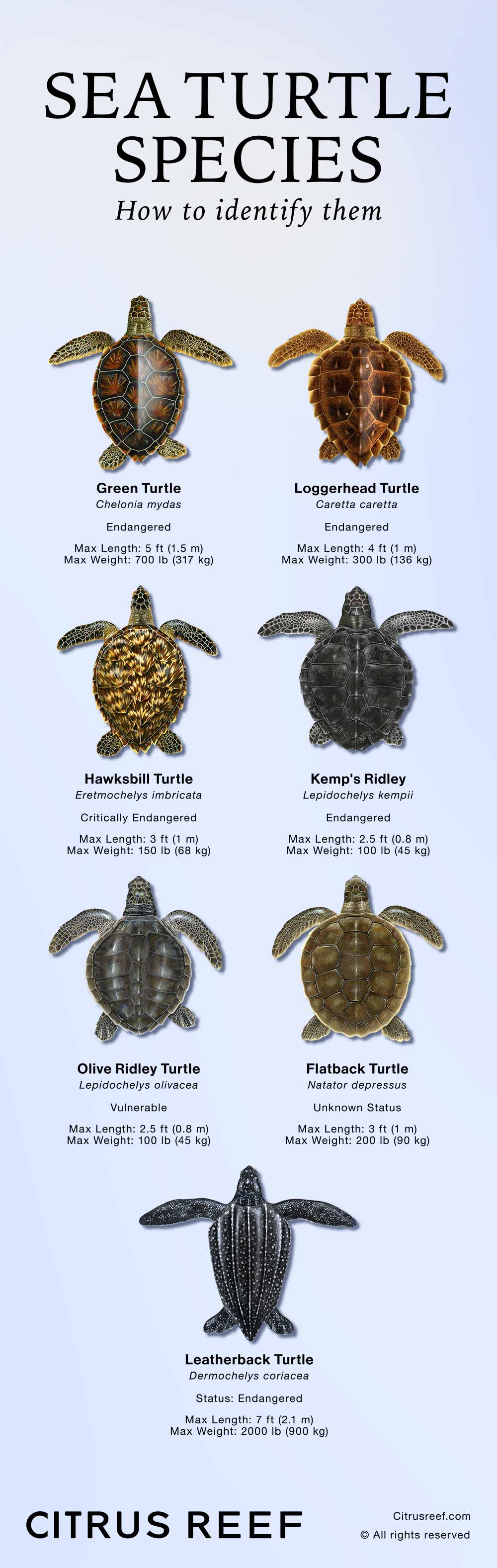
North America’s coastlines and surrounding waters are home to six of the world’s seven sea turtle species. Distinguishing them often comes down to their carapace, head, and flipper characteristics.
-
Leatherback Sea Turtle (Dermochelys coriacea):
- Distinguishing Feature: Unmistakable. Unlike all other turtles, its carapace is not bony but leathery, with seven distinct longitudinal ridges. It’s dark grey to black with white or pale spots.
- Size: The largest turtle species, reaching over 6 feet (1.8 meters) and weighing more than 1,500 pounds (680 kg).
- Habitat: Open ocean, ranging widely in temperate and tropical waters.
- Fact: Leatherbacks are deep divers, capable of descending over 3,900 feet (1,200 meters), and can tolerate cold waters due to their unique physiology.
-
Green Sea Turtle (Chelonia mydas):
- Distinguishing Feature: A relatively smooth, oval carapace, typically olive to dark brown, often with radiating streaks. They have a single pair of large prefrontal scales between their eyes (like two large plates). The common name comes from the greenish fat under their shell.
- Head: Small head relative to body, with a serrated jaw for grazing on seagrass and algae.
- Habitat: Coastal waters, seagrass beds, and coral reefs in tropical and subtropical regions.
- Fact: While juveniles are omnivorous, adult Green Sea Turtles are almost exclusively herbivorous, playing a crucial role in maintaining seagrass beds.
-
Loggerhead Sea Turtle (Caretta caretta):
- Distinguishing Feature: A large, somewhat heart-shaped head with powerful jaws, adapted for crushing shellfish. Carapace is reddish-brown, often with five pairs of costal scutes (unlike the four pairs of Green and Hawksbill).
- Head: Noticeably larger head compared to other sea turtles.
- Habitat: Temperate and tropical oceans, often found near continental shelves and estuaries.
- Fact: Loggerheads undertake extensive migrations, sometimes covering thousands of miles between feeding grounds and nesting beaches.
-
Hawksbill Sea Turtle (Eretmochelys imbricata):
- Distinguishing Feature: A narrow, pointed head with a hawk-like beak. Its most distinctive feature is the beautiful, overlapping scutes on its carapace, which are serrated along the posterior edge. Carapace color is highly variable, often with mottled patterns of brown, amber, and black.
- Habitat: Tropical coral reefs, rocky areas, and shallow coastal waters.
- Fact: Hawksbills are critically endangered, largely due to demand for their "tortoiseshell" for decorative items. They are crucial for reef health, feeding on sponges that would otherwise outcompete corals.
-
Kemp’s Ridley Sea Turtle (Lepidochelys kempii):
- Distinguishing Feature: The smallest sea turtle species, with a round to oval, olive-grey carapace. They have a single pair of large prefrontal scales.
- Habitat: Primarily Gulf of Mexico, but ranges up the Atlantic coast. Often found in shallow, coastal waters.
- Fact: Kemp’s Ridleys exhibit a unique synchronized nesting behavior called an "arribada," where thousands of females come ashore to nest simultaneously, predominantly in Rancho Nuevo, Mexico.
Freshwater Turtles: Jewels of Rivers and Ponds
North America boasts an incredible array of freshwater turtles, each adapted to specific aquatic environments.
-
Common Snapping Turtle (Chelydra serpentina):
- Distinguishing Feature: Large, prehistoric-looking. A rough, jagged-edged carapace (especially in juveniles), a long tail with saw-toothed keels, and a small plastron that doesn’t fully cover the underside. Cannot retract head fully into shell.
- Head: Large, powerful head with a strong, pointed beak.
- Habitat: Wide variety of freshwater bodies, from ponds to large rivers.
- Fact: They are opportunistic omnivores and play an important role as scavengers in aquatic ecosystems. Their bite is powerful, hence their name.
-
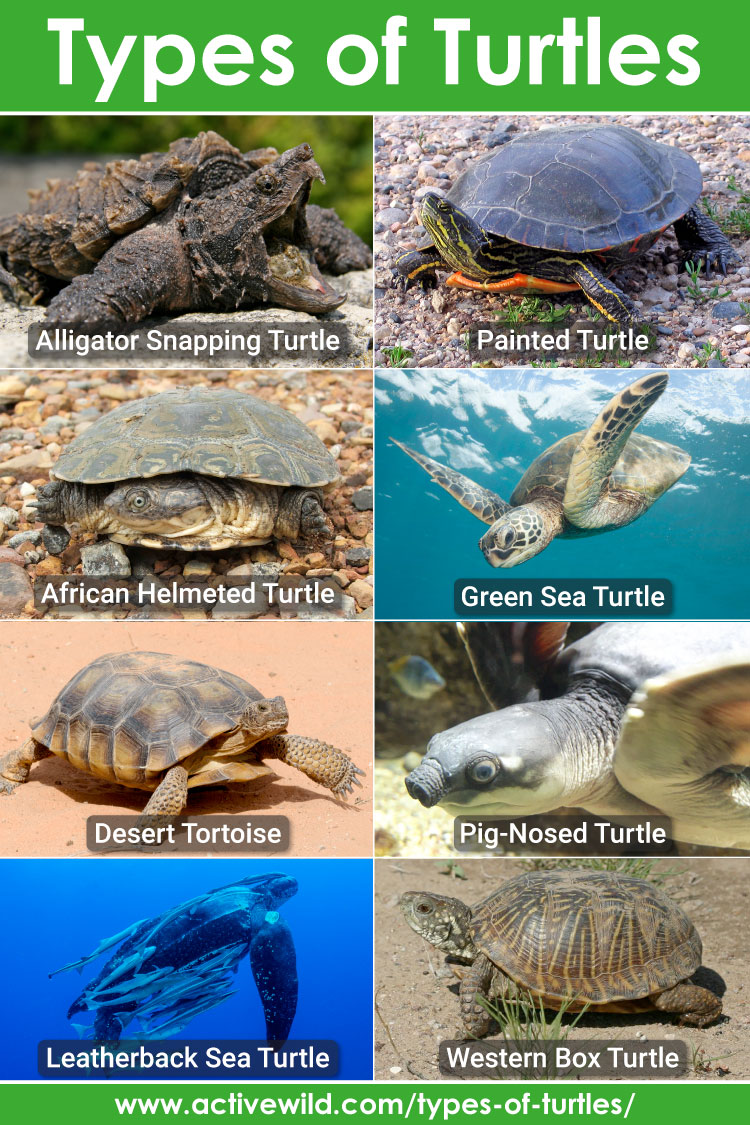
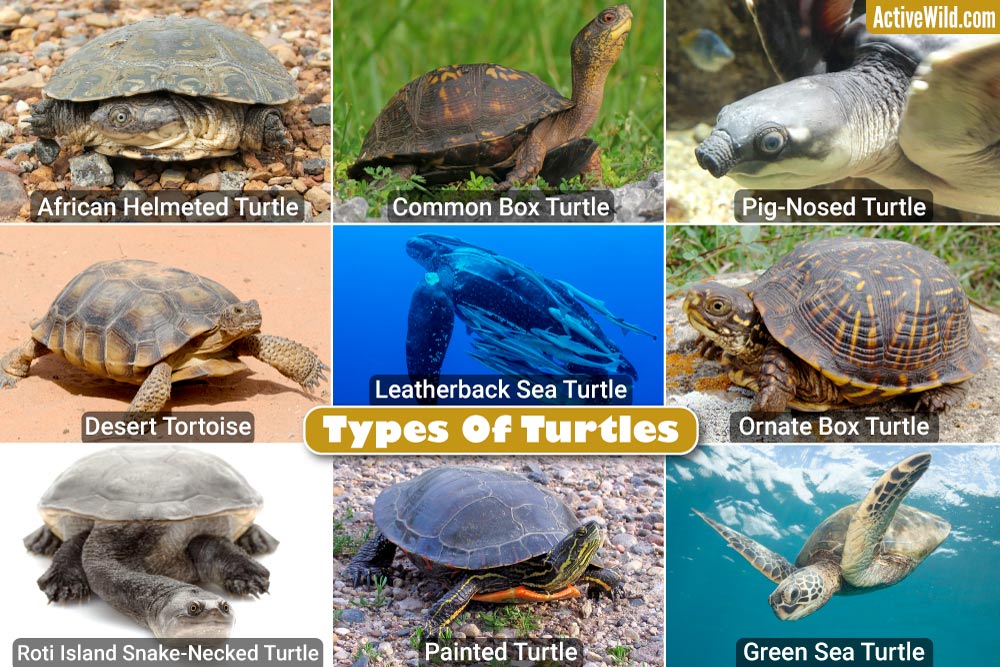
Painted Turtle (Chrysemys picta):
- Distinguishing Feature: Highly variable across four subspecies, but generally characterized by a smooth, dark, oval carapace (often black or dark olive) with red or yellow markings on the marginal scutes. The plastron is typically yellow or reddish with a central dark blotch. Distinctive red and yellow stripes on the head, neck, and legs.
- Habitat: Ponds, lakes, marshes, and slow-moving streams.
- Fact: One of the most widespread turtles in North America, known for its vibrant coloration and fondness for basking.
-
Red-eared Slider (Trachemys scripta elegans):
- Distinguishing Feature: A prominent red or orange stripe behind each eye, hence the name. Carapace is typically green with yellow markings, becoming darker with age. Plastron is yellow with dark blotches.
- Habitat: Native to the central and southern U.S., but widely introduced globally due to the pet trade, often in ponds, lakes, and canals.
- Fact: Red-eared Sliders are highly adaptable and prolific, making them a significant invasive species threat to native turtles in many parts of the world.
-
Blanding’s Turtle (Emydoidea blandingii):
- Distinguishing Feature: A highly domed, smooth, dark carapace often speckled with yellow or light spots. Its most striking feature is a bright yellow chin and throat. It possesses a hinged plastron, allowing it to partially close its shell.
- Habitat: Wetlands, marshes, shallow lakes, and slow-moving streams.
- Fact: Known for its "ever-smiling" appearance due to its mouth shape and yellow chin, the Blanding’s Turtle is a long-lived species, with individuals sometimes exceeding 70 years in age. It is a species of special concern across much of its range.
-
Map Turtles (Graptemys spp.):
- Distinguishing Feature: Named for the intricate, map-like patterns of fine yellow or orange lines on their carapace. Many species have a distinct dorsal keel (ridge) and sometimes serrated posterior margins. Females are significantly larger than males.
- Head: Often have yellow spots or lines on the head and neck.
- Habitat: Large rivers, lakes, and associated backwaters, preferring areas with abundant basking sites.
- Fact: There are numerous species of map turtles, each with subtle variations in markings and head patterns, often adapted to specific river systems, making identification challenging even for experts.
Terrestrial Tortoises: Slow and Steady on Land
While technically turtles, tortoises are exclusively terrestrial, characterized by their domed shells and elephantine, unwebbed feet.
- Gopher Tortoise (Gopherus polyphemus):
- Distinguishing Feature: A high-domed, brownish-grey carapace. Its most distinctive features are its shovel-like forelimbs, perfectly adapted for digging deep burrows.
- Habitat: Dry, sandy uplands in the southeastern United States, particularly longleaf pine forests.
- Fact: The Gopher Tortoise is a keystone species; its extensive burrows provide shelter for over 360 other animal species, including snakes, frogs, and insects, making it an ecological engineer of its habitat.
The Call to Action: Be an Identifier
The ability to identify these incredible creatures is more than just knowing a name; it’s a doorway to understanding their unique lives, their struggles, and their vital roles in the ecosystems of Turtle Island. Whether you’re a casual observer, a budding naturalist, or a dedicated conservationist, learning to decode the shell, the scutes, and the subtle markings of these ancient mariners and land-dwellers is a powerful step towards becoming a steward of our natural world. Resources abound, from field guides and online databases (like the IUCN Red List or state wildlife agency websites) to citizen science apps like iNaturalist. By honing our identification skills, we contribute directly to the knowledge base necessary to protect these living legends for generations to come, ensuring that Turtle Island remains a sanctuary for its namesake inhabitants.


