
Echoes of the Land: The Enduring Legacy of Native American Language Families
The vast and ancient lands of North America once thrummed with a symphony of human voices, each articulating a unique understanding of the world, woven into the very fabric of its landscape. Before European contact, an estimated 300 to 500 distinct Native American languages flourished north of Mexico, belonging to more than 50 different language families—a linguistic diversity comparable to all of Europe. These are not mere dialects, but entire families of languages, each as distinct from the other as English is from Chinese, carrying within them millennia of history, culture, and profound connection to the land.
The story of Native American language families is a saga of immense depth, resilience, and heartbreaking loss, now increasingly marked by a fervent push for revitalization. It is a testament to the human capacity for expression and the critical role language plays in shaping identity and worldview.
A Pre-Columbian Tapestry: Deep Time and Diverse Roots
To understand the scope of Native American linguistic diversity, one must journey back into deep time. The peopling of the Americas, a process spanning tens of thousands of years, brought with it successive waves of migrations, each potentially introducing new linguistic lineages. Over millennia, these proto-languages diversified, evolving into the myriad tongues encountered by European explorers.
Unlike the relatively few, large language families that dominate Europe and Asia (Indo-European, Sino-Tibetan), North America exhibited a fragmented, intricate linguistic mosaic. This complexity hints at long periods of independent development and geographic isolation, allowing distinct linguistic structures to emerge and flourish.
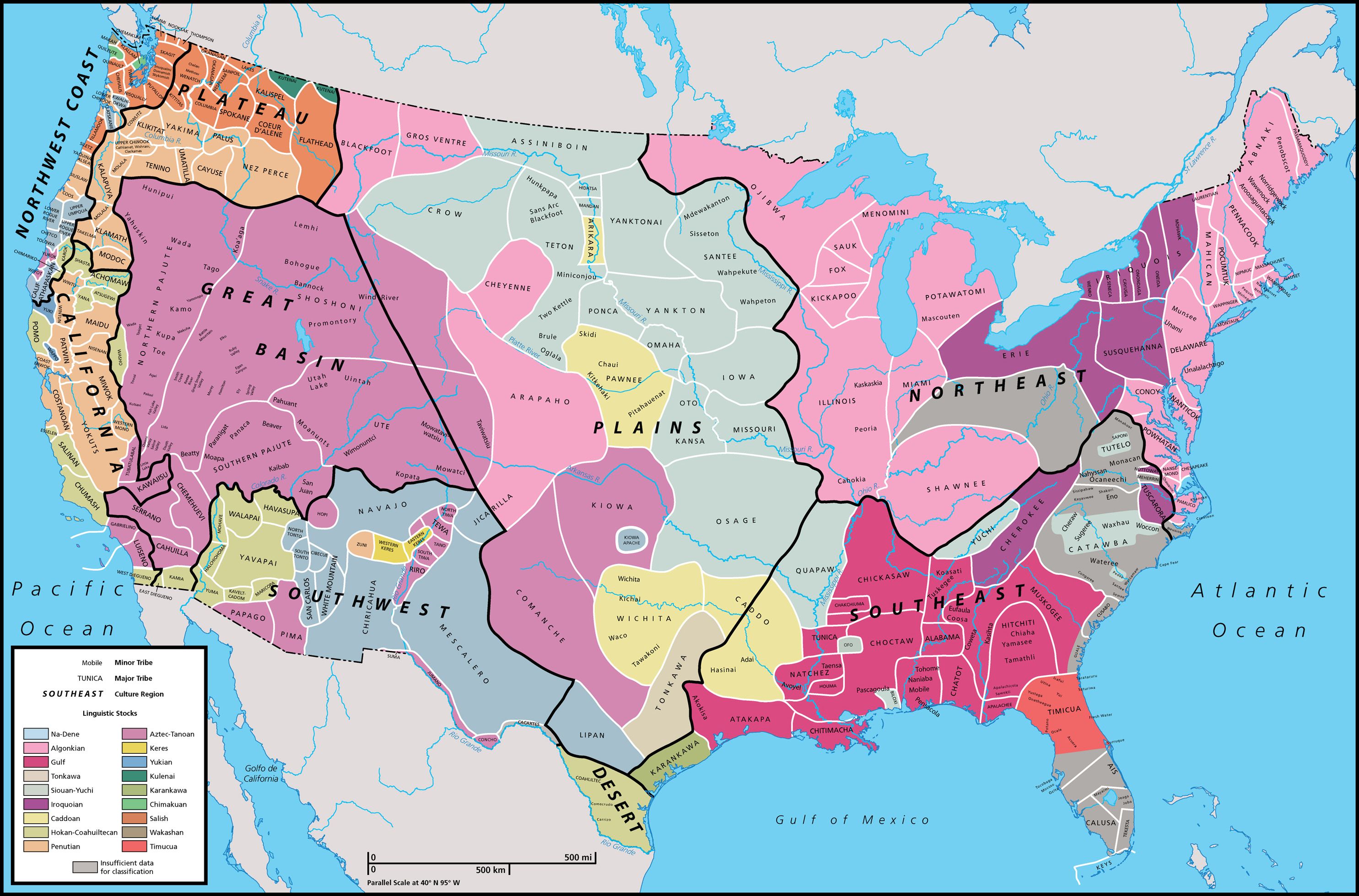
Linguists group these languages into "families" based on shared ancestry, much like Romance languages (French, Spanish, Italian) descend from Latin. However, the relationships between many Native American language families are often far more ancient and complex, with some families comprising only a handful of languages, and others being "isolates"—languages with no known living relatives, like Kutenai or Zuni, representing unique linguistic evolutionary paths.
A Glimpse into Major Language Families:
1. Algonquian: Spanning vast stretches of the East Coast, Great Lakes, and Canadian Prairies, the Algonquian family is one of the most geographically widespread. Languages like Ojibwe (Anishinaabemowin), Cree, Blackfoot, Cheyenne, and Arapaho belong to this family. They are renowned for their polysynthetic nature, meaning words are often complex, incorporating many morphemes (meaningful units) to express concepts that would require entire sentences in English. An Ojibwe word like gikenindamowinan can mean "knowledge" or "things that are known."
2. Iroquoian: Centered in the Northeast and Great Lakes region, the Iroquoian family includes languages such as Mohawk, Oneida, Seneca, and the historically significant Cherokee. These languages are known for their distinct phonologies and often reflect the matrilineal social structures of their speakers. The Cherokee language holds a unique place in history due to Sequoyah’s syllabary, completed in 1821. This remarkable achievement allowed the Cherokee Nation to achieve near-universal literacy within a decade, printing newspapers and books, a feat virtually unparalleled by any non-literate society. It stands as a powerful testament to the ingenuity and adaptability of Native American intellectual traditions.
3. Siouan-Catawban: Predominantly found in the Great Plains, but with historical ties to the Southeast, this family includes languages like Lakota, Dakota, Omaha, and Crow. These languages are often characterized by rich oral traditions, with storytelling and ceremonial speeches playing a central role in cultural transmission. The Lakota language, for instance, is deeply intertwined with the spiritual practices and worldview of the Lakota people.
4. Uto-Aztecan: This is one of the largest families in terms of both the number of languages and historical speakers, stretching from the Great Basin of the United States deep into Central Mexico. It includes languages like Nahuatl (the language of the Aztec Empire), Hopi, Shoshone, Ute, and Paiute. The vast geographic spread and diverse cultural groups speaking Uto-Aztecan languages highlight ancient migration patterns and significant cultural exchanges across a broad swathe of North America.
5. Athabaskan (Na-Dene): This family is geographically disparate, with Northern Athabaskan languages in Alaska and Western Canada (e.g., Dene, Gwich’in) and Southern Athabaskan languages in the American Southwest (e.g., Navajo, Apache). The Na-Dene hypothesis also links Athabaskan to Eyak and Tlingit, suggesting an ancient migration from Beringia. The Navajo language (Diné bizaad) is the most widely spoken Native American language today, with over 150,000 speakers. Its unique structure and complexity famously made it an unbreakable code during World War II, when Navajo Code Talkers transmitted vital military messages, playing a crucial role in Allied victories.
6. Salishan & Wakashan: Located in the Pacific Northwest, these families are renowned for their intricate sound systems, often featuring numerous consonants and complex phonological rules that can be challenging for non-native speakers. Languages like Lushootseed, Salish, Kwak’wala, and Nootka are deeply connected to the rich marine environments and artistic traditions of their speakers.
Beyond these major families, numerous others like Muskogean (Choctaw, Creek), Caddoan (Pawnee, Wichita), and Penutian (a proposed macro-family including languages like Klamath, Nez Perce) further illustrate the extraordinary linguistic richness that once defined the continent.

The Cataclysm and Decline: A Century of Silence
The arrival of European colonizers heralded a catastrophic period for Native American languages. The forces of disease, warfare, and forced displacement decimated populations, often taking entire linguistic communities with them. However, the most insidious and deliberate assault on Native languages came through systematic policies of assimilation.
From the 19th through the mid-20th centuries, the U.S. and Canadian governments implemented policies aimed at eradicating Native cultures, believing that language was the key to this process. Indian boarding schools (residential schools in Canada) became instruments of cultural genocide. Native children were forcibly removed from their families, forbidden to speak their ancestral languages, and punished—often severely—for doing so. Their hair was cut, traditional clothing replaced, and names changed. The mantra was "kill the Indian, save the man."
This systematic suppression created generations of "silent speakers"—individuals who understood their language but were too traumatized to speak it, or who chose not to teach it to their children to protect them from similar suffering. The intergenerational transmission, the very lifeblood of language, was severed. As a result, by the mid-20th century, many Native American languages were on the brink of extinction, with only a handful of elderly speakers remaining. "It’s hard to rebuild a bridge when all the pieces have been thrown into the river," observed a Potawatomi elder, reflecting on the profound damage.
Resilience and Revitalization: A New Dawn
Despite the devastating losses, Native American languages have shown remarkable resilience. The latter half of the 20th century, particularly following the Civil Rights Movement and a renewed emphasis on self-determination for Native nations, saw the beginning of a powerful revitalization movement.
Today, communities across North America are fighting tirelessly to reclaim their linguistic heritage. This effort is driven by the profound understanding that language is inextricably linked to identity, worldview, and cultural survival. As the late Chief Phillip Martin of the Mississippi Band of Choctaw Indians famously said, "Without our language, we lose our way of thinking, our way of praying, and our way of understanding the world."
Revitalization efforts take many forms:
- Immersion Schools and Language Nests: Programs where young children are immersed exclusively in their tribal language, often from infancy, aiming to create a new generation of first-language speakers.
- Master-Apprentice Programs: Connecting fluent elders with motivated learners in intensive, one-on-one settings, often over several years.
- Curriculum Development: Creating teaching materials, dictionaries, and grammars in Native languages for all age groups.
- Digital Tools: Leveraging technology with language apps, online dictionaries, social media groups, and YouTube channels to make learning accessible and engaging.
- Community Engagement: Promoting language use in everyday life, from tribal government meetings to family gatherings and ceremonies.
- Legal Protections: The Native American Languages Act of 1990 in the U.S. declared a policy to "preserve, protect, and promote the rights and freedom of Native Americans to use, practice, and develop Native American languages," providing crucial federal support.
While the challenges remain immense—many languages have fewer than a dozen fluent speakers, and funding is often scarce—the passion and dedication are undeniable. Youth are increasingly embracing their ancestral tongues, seeing them as a source of strength and pride. Elders, who once bore the trauma of suppression, are now celebrated as invaluable linguistic treasures.
The Future: A Living Legacy
The history of Native American language families is a microcosm of human linguistic diversity—its ancient origins, complex evolution, and vulnerability to external pressures. It is a story that reminds us that language is not merely a tool for communication; it is a repository of knowledge, a carrier of culture, a spiritual conduit, and a living testament to a people’s enduring presence on their ancestral lands.
The fight to save these languages is a fight for global linguistic diversity, for cultural survival, and for the inherent right of every people to define themselves in their own words. As the voices of ancestors echo from the past, a new generation is ensuring that the symphony of Native American languages will continue to resonate across the land, enriching the tapestry of human experience for centuries to come. The future of these languages, while fragile, is held firmly in the hands of those who understand that in every word, a world is preserved.


