

The Enduring Canvas of Turtle Island: A Journey Through Indigenous Art History
The art history of Turtle Island, the Indigenous name for North America, is not a static chronicle of past civilizations but a vibrant, continuous narrative stretching back millennia. It is a testament to the profound spiritual, cultural, and material ingenuity of hundreds of distinct nations, each with its unique aesthetic traditions, cosmologies, and forms of expression. Far from being mere artifacts, these artworks – whether ancient petroglyphs, intricate regalia, contemporary installations, or digital media – are living testaments to resilience, sovereignty, and an unbreakable connection to land, language, and community.
To truly grasp the breadth of this artistic legacy is to understand it as a dynamic dialogue between tradition and innovation, shaped by deep ancestral knowledge, adaptation, and, crucially, resistance against centuries of colonial pressures. This is an art history that defies easy categorization, demanding respect for its diversity and its ongoing evolution.
Deep Roots: Art from Time Immemorial
The earliest artistic expressions on Turtle Island date back at least 15,000 years, coinciding with the arrival of the first peoples. These initial works often took the form of rock art – petroglyphs (carvings) and pictographs (paintings) – found across the continent. Sites like Petroglyph Provincial Park in Ontario, Canada, or Writing-on-Stone Provincial Park in Alberta, Canada, (known as Áísínai’pi by the Blackfoot, meaning "it is pictured/written") showcase thousands of images depicting human figures, animals, spirits, and narrative scenes, serving as spiritual records, teaching tools, and territorial markers. These images are not just decorative; they are integral to oral histories and spiritual practices, providing windows into ancient worldviews.
As societies evolved, so too did artistic complexity. The Archaic period (8000–1000 BCE) saw the emergence of sophisticated basketry, fiber arts, and carved stone objects. One of the most remarkable examples is Poverty Point in Louisiana, dating back to 1700–1100 BCE, an immense earthwork complex featuring six concentric ridges and mounds. While not "art" in the conventional sense, its monumental scale and precise astronomical alignments speak to a profound aesthetic and engineering vision, demonstrating the capacity for vast communal projects driven by spiritual and social cohesion.
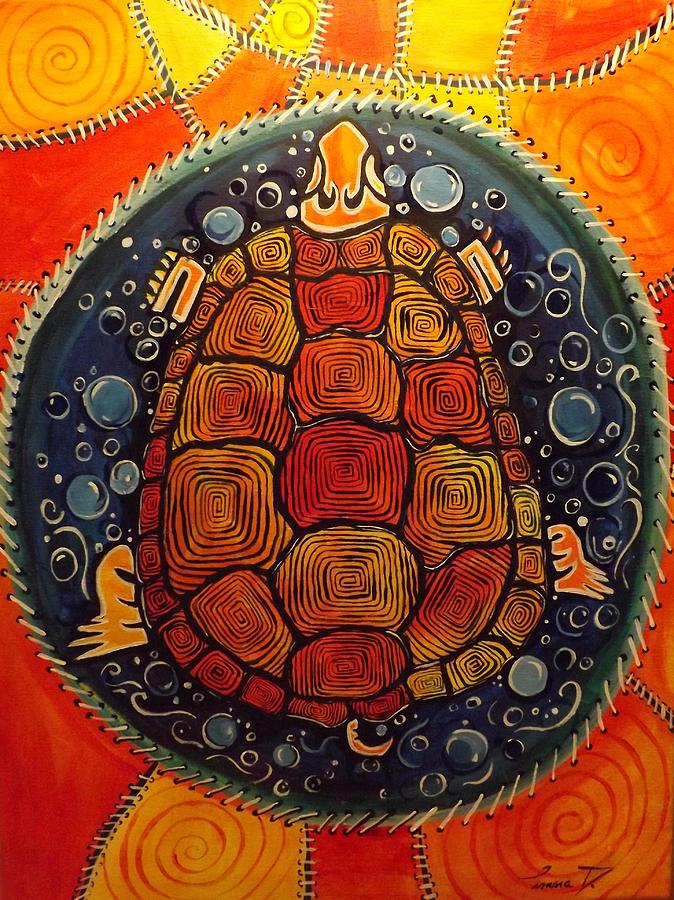

The Woodland (1000 BCE – 1000 CE) and Mississippian (800–1600 CE) cultures of the Eastern and Southeastern United States produced exquisite pottery, effigy pipes, copper repoussé, and shell gorgets (necklaces) depicting mythical creatures, ceremonial figures, and cosmological symbols. The Great Serpent Mound in Ohio, an effigy mound stretching over 1,300 feet, is a powerful example of earthwork art imbued with astronomical and spiritual significance, a landscape sculpture that interacts directly with the cosmos. These cultures developed extensive trade networks, disseminating artistic styles and materials across vast distances, demonstrating a connected and vibrant artistic exchange long before European contact.
Adaptation and Resistance: Art in the Face of Colonialism
The arrival of European colonizers fundamentally altered the trajectory of Indigenous art. While initial encounters often involved trade – leading to the integration of new materials like glass beads, metal tools, and commercial dyes into traditional art forms – the subsequent centuries brought devastating policies aimed at cultural assimilation and eradication. The Indian Act of 1876 in Canada and similar policies in the United States actively suppressed Indigenous languages, spiritual practices, and ceremonial arts.
Perhaps the most infamous example is the Potlatch Ban (1884-1951) in Canada, which outlawed the central ceremonial feast of the Pacific Northwest Coast peoples. Potlatches were vital for validating social status, transferring names and privileges, and showcasing ceremonial regalia, masks, and carved objects like totem poles. The ban led to the confiscation of vast collections of ceremonial art, much of which ended up in museums and private collections, both within Canada and internationally. Despite these oppressive measures, artists continued to create, often in secret, adapting their work to survive. Masks were sometimes simplified or made smaller to be hidden, and narratives were encoded in seemingly innocuous objects. This period highlights art not just as an aesthetic pursuit but as an act of profound cultural and spiritual resistance, a means of preserving identity against immense pressure.
Across the Plains, the introduction of horses and trade goods like glass beads transformed artistic practices. Hide painting, traditionally used for tipis, robes, and shields, evolved into ledger art – drawings on discarded ledger books, paper, and cloth, often depicting historical events, battle scenes, and daily life. These works, many created by warriors imprisoned in the late 19th century, served as vital historical records and personal narratives, continuing a tradition of visual storytelling with new materials.
Revitalization and Reclaiming Narratives: The Mid-20th Century to Today
The mid-20th century marked a critical turning point. With the lifting of oppressive legislation like the Potlatch Ban and the rise of Indigenous rights movements, a powerful resurgence of artistic production began. Artists, often inspired by their elders and ancestral works in museums (sometimes controversially), began to reclaim and revitalize traditional forms while simultaneously pushing the boundaries of contemporary art.
The Pacific Northwest Coast witnessed a remarkable artistic renaissance, spearheaded by figures like Bill Reid (Haida). Reid, a master goldsmith, carver, and sculptor, became instrumental in re-establishing the global prominence of Haida art. His monumental sculptures, such as The Spirit of Haida Gwaii (found in Vancouver and at the Canadian Embassy in Washington, D.C.), combine traditional Haida forms with contemporary sensibilities, symbolizing the strength and continuity of his people. Artists like Robert Davidson (Haida) further propelled this movement, emphasizing both the technical mastery and spiritual depth of Haida art, creating powerful masks, totems, and prints that resonate internationally.
In the Woodlands region, artists like Norval Morrisseau (Anishinaabe) emerged as a pivotal figure. Often called the "Picasso of the North," Morrisseau developed the distinct Woodland School or "legend painting" style, characterized by bold outlines, x-ray views of figures, and vibrant colors. His work, deeply rooted in Anishinaabe cosmology and spiritual visions, aimed to visually articulate Indigenous spirituality for both Indigenous and non-Indigenous audiences, breaking taboos and sharing sacred knowledge. He opened the doors for a generation of artists, including Daphne Odjig (Anishinaabe/Potawatomi), a founding member of the Professional Native Indian Artists Association ("Indian Group of Seven"), who championed Indigenous artists and their unique perspectives.
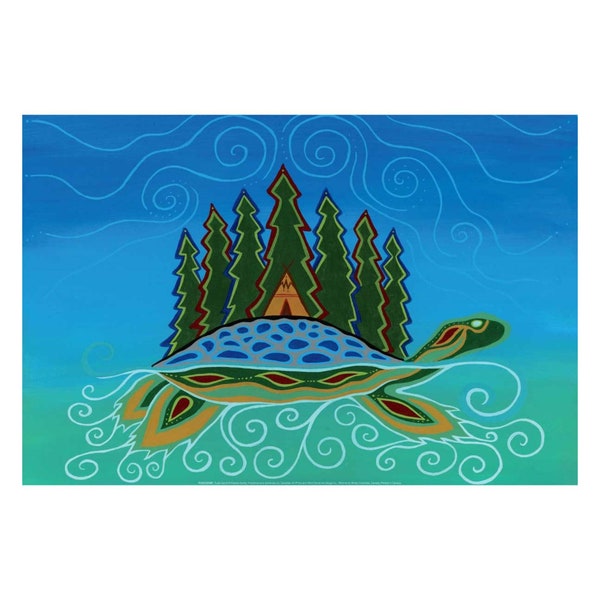

The Southwest continued its legacy of exceptional pottery and weaving. Maria Martinez (San Ildefonso Pueblo), in the early 20th century, famously revived the ancient black-on-black pottery technique, transforming it into a celebrated art form that combined ancestral knowledge with innovative design, bringing economic self-sufficiency to her community. The Diné (Navajo) weavers continued their centuries-old tradition, adapting patterns and dyes, with their intricate rugs and tapestries becoming highly sought after for their artistic merit and cultural significance.
Contemporary Indigenous Art: A Global Dialogue
Today, Indigenous art on Turtle Island is a multifaceted, globally recognized force. Contemporary artists work across virtually all media – painting, sculpture, photography, video, installation, performance, digital art – engaging with a complex array of themes. They challenge colonial narratives, confront historical trauma (such as the legacy of residential schools), explore identity in a globalized world, address environmental concerns, and celebrate cultural resilience and sovereignty.
Kent Monkman (Cree), through his alter ego Miss Chief Eagle Testickle, re-appropriates historical European paintings, inserting Indigenous figures and narratives to subvert colonial perspectives and critique the romanticized gaze. His work provocatively addresses themes of sexuality, residential schools, and the ongoing impact of colonialism. Christi Belcourt (Métis) creates intricate paintings inspired by Métis floral beadwork, often addressing environmental justice and land rights, using her art as a form of activism and cultural revitalization.
Rebecca Belmore (Anishinaabe), a performance and installation artist, uses her body and site-specific works to confront issues of violence against Indigenous women, land dispossession, and historical memory, often with raw emotional power. Brian Jungen (Dane-zaa/Swiss-Canadian) ingeniously transforms mass-produced consumer goods, like plastic chairs or sports equipment, into sculptures that mimic traditional Indigenous forms, questioning authenticity, commodity culture, and the impact of globalization on Indigenous communities.
This contemporary wave of Indigenous art is not merely about preserving the past; it is about actively shaping the present and future. It speaks to the ongoing process of decolonization, where artists reclaim their agency, challenge dominant historical narratives, and assert their cultural sovereignty. Museums and galleries are increasingly working to decolonize their collections and curatorial practices, creating spaces for Indigenous voices and perspectives to be heard and seen on their own terms.
Conclusion: Art as Living Tradition
The art history of Turtle Island is a testament to the profound and enduring spirit of Indigenous peoples. It is a narrative woven through millennia, marked by innovation, adaptation, and unwavering resilience. From the ancient marks on stone to the digital expressions of today, Indigenous art serves as a powerful conduit for knowledge, spirituality, identity, and political voice. It is a living, breathing tradition that continues to evolve, challenging preconceived notions, demanding recognition, and enriching the global artistic landscape with its profound beauty, complexity, and unwavering commitment to cultural continuity and self-determination. Far from being a relic of the past, Indigenous art on Turtle Island stands as a dynamic, vital force, constantly reasserting its presence and its power in the 21st century and beyond.


